 I’m feeling a bit listless today, so how about a puzzle break? My gut feeling is that the Venn diagram of mystery lovers and puzzle lovers has a huge overlap. The Puzzle Doctor has finally capitulated to nagging on multiple fronts and begun to post about his experience at the World Puzzle Championships. I once applied to enter, many moons ago, but never got further than the application stage (and I may even have been very naughty and lied about my age, so it’s probably best I didn’t get through…) Continue reading
Category Archives: Real-Life
clueQuest: Plan52 (London, August 2014)
 I feel like I’ve spent all bank holiday carping about people more creative than me. Time for something a bit more positive: clueQuest. I played this in London a few weeks ago and it was a lot of fun. Definitely recommended. Not so recommended that I don’t have some criticisms (of course!), but it was an unusual hour well-spent and worth the money. Part of the enjoyment was due to the ingenuity of the puzzles, so I’m going to arrange this review in order of increasing spoilerness. At the request of the game staff I’m not going to spoil many specifics, but if you’re in the London area and this seems like something you’d like to do, stop reading about halfway through. Continue reading
Mephisto
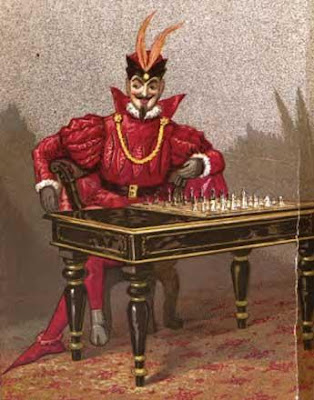 I’ve been pretty ill this weekend, so just a quick real-life mystery today. As is usual in the new year, I’ve been rooting through old notebooks to see which half-formed plots I’ve got buried there still interest me. My post about the Chess Mysteries of Sherlock Holmes reminded me about an idea for a plot about a chess automaton.
In my story, naturally the automaton appears to commit a dastardly crime: in this case, the murder of a chess champion during a chess demonstration, on stage in front of hundreds of a people. I’m pretty pleased with my “design” for the automaton and the subsequent murder. The automaton is shaped like the goddess of chess Caissa, and she’s unpacked and constructed from her component parts in full view of the audience before the game begins, to prove that there’s no-one concealed inside. I’m pretty sure it would work, and in fact I’m surprised that none of the automata exhibited at the time employed a similar trick. Now all I need is an actual plot to go with the crime!
Automata don’t feature as much in mystery fiction as you might expect. Despite being incredibly creepy, and an obvious candidate for “impossible” murders, there’s only really The Crooked Hinge by John Dickson Carr, and that’s a real hodge-podge of brilliant ideas and terrible execution.
Chess automata were a huge phenomenon in the 18th and 19th centuries, mechanical figures which could apparently play chess of their own accord. The Turk is the most famous, but there were quite a few which toured Europe and America, playing against the public, chess masters, celebrities and even royalty. Most of them were simply elaborate trick cabinets; the operator would open various windows in the base to show that they were apparently filled with cogs, but actually there was space for a human player to be concealed inside and operate the machine.
But Mephisto was different, apparently. Designed as a stylized devil, Mephisto was apparently “remotely controlled by electromechanical means”. But beyond that it’s hard to find any concrete information about it. How did it work? Or how might such a machine work? Was it just a cover story to distract from another concealed player, or was it really possible in 1876 to design an electromechanically operated arm that could move chess pieces around a board?
 Complete Disregard for Spoilers