Time for the second part of my Solve-Along for The Skeleton in the Clock. Part one can be found here.
Category Archives: Criticism
clueQuest: Plan52 (London, August 2014)
 I feel like I’ve spent all bank holiday carping about people more creative than me. Time for something a bit more positive: clueQuest. I played this in London a few weeks ago and it was a lot of fun. Definitely recommended. Not so recommended that I don’t have some criticisms (of course!), but it was an unusual hour well-spent and worth the money. Part of the enjoyment was due to the ingenuity of the puzzles, so I’m going to arrange this review in order of increasing spoilerness. At the request of the game staff I’m not going to spoil many specifics, but if you’re in the London area and this seems like something you’d like to do, stop reading about halfway through. Continue reading
Solve-Along: The Skeleton in the Clock (Part 1)
 Solve-Along time, I reckon.
If you haven’t read one of these before, I write up my thoughts on a mystery as I go along, and try and solve it before the end. To avoid devastating people with spoilers, I try to pick books that are very obscure or have had poor reviews. This time, it’s Carter Dickson’s The Skeleton in the Clock. Continue reading
Sister (Rosamund Lupton, 2010)
 A bit of a departure for me, this, but I’ve been ill and it was the first book that fell to the ground when I flailed at the bookcase. I don’t know where I got it from. I think it was recommended as part of the Richard and Judy book club, which is a sort of low-rent version of Oprah’s book club here in the UK. It’s surprisingly good, at least for the first two-thirds. Sensitively drawn but densely layered. Unfortunately it descends into implausibility in the final stretch, and the closing twist, while ambitious, doesn’t make much sense in light of what’s gone before. But worth a read.
Anyway, that’s your lot if you’re trying to avoid spoilers. After the cut I’ll be talking about the whole thing, including that final twist. Continue reading
A Chess Mystery
Research for my new plot continues apace. By which I mean I’ve been ill in bed reading books about 19th century chess in between vomit attacks. When I’m better I’ll probably look at my “detailed notes” and find they’re nothing but skulls and question marks. One interesting problem when writing about specialized topics is how much detail to go into. Too much and you risk alienating all but the most hard-core audience, but too little and a story can seem insubstantial. This is too complicated a topic to get into when I’m semi-delirious on a Sunday evening, but what I do find interesting is how badly chess has been handled in the past. Here are some examples:
Death in Paradise, Series 3, Episode 2 (BBC, 2014)
 So I was entirely right in my predictions. Which isn’t necessarily a problem. As I said in my longer review of episode 1, a mystery being obvious isn’t necessarily a failing. Plenty of puzzles are designed to be solved. What’s more of a problem is the generally shoddy nature of the script in this second episode: a lot of clichés and half-hearted jokes, combined with a lot of scenes that just petered out into shrugs and knowing glances at Goodman’s clumsiness. I appreciate that Death in Paradise is a gentle, unchallenging show, but that’s no excuse for such insipid writing. Hopefully it’s just a blip. It’s a shame that such a weak episode came so early in Kris Marshall’s run. We’re still learning about his character, and early interactions make a much stronger impression on an audience than later ones. If this had been episode 7 or 8 in the series it would have felt less detrimental. As it was, it was the first time watching Death in Paradise that I considered skipping to the end. Continue reading
Phoenix Wright, Dual Destinies (Capcom, 2013)
 I’m slowly crawling my way through the latest Phoenix Wright game, Dual Destinies. I want to like them: the bombastic courtroom setting is funny; the impossible crimes are intricate and original. But they’re just so boring. Every possible ounce of subtlety is drained by a script that’s petrified you might misunderstand what’s going on. So the characters’ feelings are explained, at length, and then repeated again five minutes later. Clues and themes are reiterated again and again until it’s impossible to care any more.
Some of this is understandable. I tend to play each case straight through, but they’re also designed to be enjoyed in very short chunks. If someone is playing for five minutes every other day then repeating things is the only way to ensure they don’t get confused.
But the script doesn’t need to be so banal; endless platitudes and exaggerated shock or misery at every tiny setback or twist in the plot. Take this, for example:
“This is a homicide any way you slice it. In other words, we have a murder on our hands.”
Is there any context where that’s not a terrible line of dialogue?
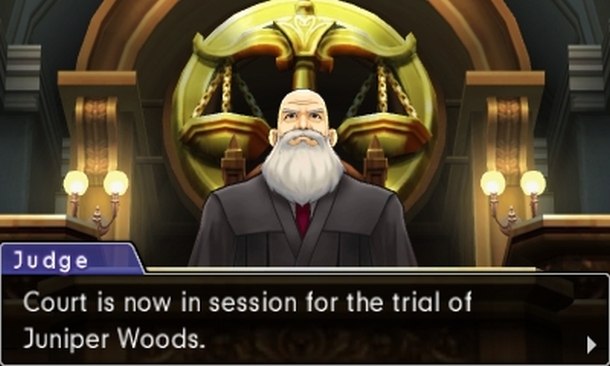 The biggest shame is that this most recent iteration actually has a better calibre of writing and plotting. The mysteries so far have been interesting, with genuinely clever third act twists. But the actual technical standard of the writing, the boring nuts and bolts of spelling and punctuation, has never been lower. I’d say as many 10% of the lines have errors, most often missing pronouns or mangled tenses like “Let’s see if the defense can response”. Apollo Justice, one of the main characters, talks about his “Chords of Steel”. It’s a common enough error, but the writers should know better: they’re vocal cords – physical cords of flesh. Much of the overarching plot revolves around bombs, but the writers don’t know the difference between “diffuse” and “defuse”. As an editor I understand that no long piece of text is ever going to be perfect, but Dual Destinies reads like no-one ever bothered to proof it at all.
And it’s not like the story branches or the text is procedurally generated, common difficulties in editing video game stories. The Phoenix Wright games are as linear as they get, and any given player is going to see the same 90% of the game text, in the same order. The developers could have printed it out and given it to people to read like a screenplay.
This is a full price game. I know how little proofreaders get paid. Can it really be worth putting out such a shoddy product to save the price of a dozen units?
Death in Paradise, Series 3 Episode 1 (BBC, 2014)
 So Richard Poole is out, Humphrey Goodman is in. Killing off the main character in a light-hearted mystery show is a long way from ideal, and I must admit I was surprised. They had a perfectly good excuse for Richard to leave at the end of Series 2, which would have rounded out his and Camille’s arc nicely. But perhaps Ben Miller pulled out after those scenes had been finalised. If that’s the case, then I think they’ve done the best they could with a very difficult situation. The new detective seems an amiable enough chap, and the soap opera is so low-key that I expect after a few episodes Richard Poole will be entirely forgotten. In fact, it’s probably a good thing that Poole is gone, because there wasn’t really anywhere sensible left to take the relationship between him and Camille. Continue reading
Sherlock: His Last Vow (BBC, 2014)
Interesting reactions to yesterday’s Sherlock finale. Mostly adulation, but some murmurs of discontent at the ending, including from my mother, who if it wasn’t for a lifetime of prudery would be a fully signed up Cumberbitch.
But at the risk of rank presumption, I’m going to suggest that people haven’t quite identified the source of their own discomfort. Obviously there’ll be massive spoilers for His Last Vow after the cut. Continue reading
Father Brown, Series 1 Episode 8 (BBC, 2013)

I still haven’t got round to watching any of the new Father Brown series, but Wednesday’s post reminded me of an unusual and instructive error that cropped up in episode 8 of the last series, The Face of Death. Continue reading
 Complete Disregard for Spoilers